Introduction: The Era Beyond Smartphones Is Here
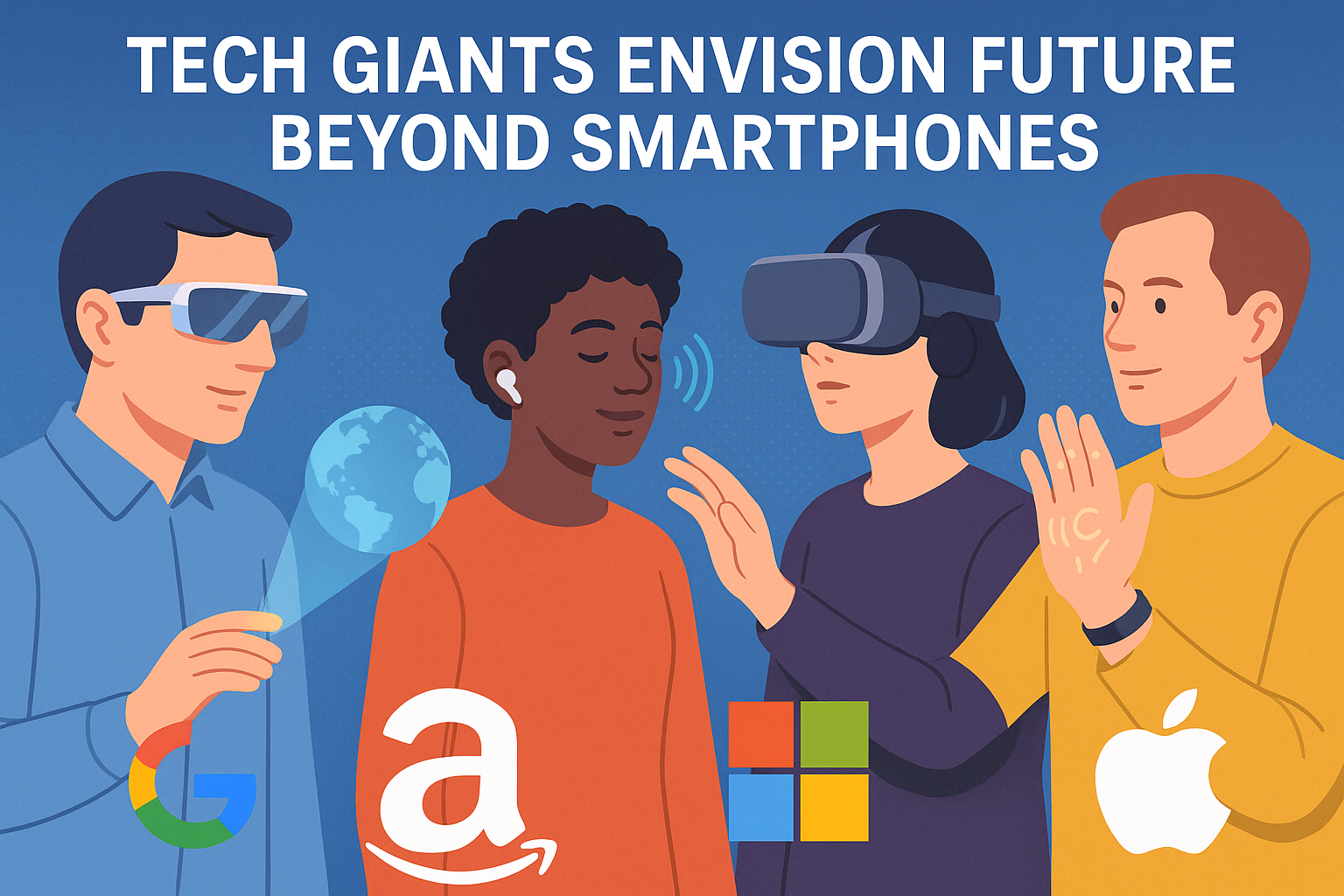
Smartphones have been the cornerstone of personal technology for over a decade. But as innovation accelerates and consumer needs evolve, tech giants envision a future beyond smartphones—a world where immersive experiences, wearables, and AI-driven interfaces redefine how we interact with technology.
From Apple and Google to Meta and Samsung, global leaders are investing billions into post-smartphone ecosystems. This article explores how these companies are shaping a world that moves beyond the limits of traditional handheld devices.
Why Move Beyond Smartphones?
Despite their dominance, smartphones are nearing a saturation point. Consumers demand more intuitive, immersive, and seamless technology. Several trends are driving this shift:
-
Wearable tech is gaining popularity. Smartwatches, AR glasses, and health trackers offer functionality without constant screen interaction.
-
Voice and gesture controls are maturing, reducing the need for touch-based inputs.
-
The rise of spatial computing and AI enables devices to understand context and environment, changing how we interact with digital tools.
Most importantly, user behavior is evolving. People want less screen time and more integration with their daily lives—tech that works in the background, not at the center.
Key Players Pioneering the Shift
1. Apple: Vision Pro and Spatial Computing
Apple’s launch of the Vision Pro is a clear signal of its ambition to lead the post-smartphone era. Marketed as a “spatial computer,” the Vision Pro blends augmented reality (AR) with real-time interaction using eye tracking, hand gestures, and voice.
With VisionOS, Apple is laying the groundwork for an ecosystem where AR replaces mobile screens for entertainment, productivity, and communication.
2. Meta: Building the Metaverse
While Meta’s metaverse ambitions faced early skepticism, the company remains focused on creating an immersive, virtual-first future. Its Quest VR headsets are growing more powerful, lighter, and affordable, aiming to replace traditional devices for gaming, meetings, and social interaction.
Meta envisions a digital landscape where smartphones are just one access point among many—no longer the center of gravity.
3. Google: Ambient Computing & AI
Google is investing heavily in ambient computing—a concept where devices blend seamlessly into your environment. The goal is for users to interact naturally with their surroundings using Google Assistant, Nest products, Pixel wearables, and upcoming AR tools.
AI plays a central role. With tools like Gemini AI and advanced language models, Google aims to build interfaces that anticipate user needs without constant input.
4. Samsung: Foldables, XR, and Wearables
Samsung is betting on a multi-device ecosystem. It continues to refine foldable smartphones, while also exploring extended reality (XR) and bio-integrated wearables.
In 2024, Samsung partnered with Google and Qualcomm to develop a mixed reality (MR) headset, expected to debut in the next year. Their combined hardware-software ecosystem could challenge Apple’s Vision Pro directly.
Technologies Powering the Post-Smartphone World
A. Augmented and Virtual Reality
AR and VR create immersive digital experiences. Instead of typing on screens, users interact with 3D interfaces through gestures, gaze, and voice.
B. Artificial Intelligence and Natural Language Processing
AI will be key to contextual computing—helping systems understand your environment, preferences, and behavior. With smarter voice assistants, real-time translation, and adaptive UIs, users won’t need to “use” tech—it will just work.
C. Brain-Computer Interfaces (BCI)
Though still in early stages, Neuralink and similar projects envision a world where thoughts can control machines. BCIs could ultimately eliminate the need for physical interfaces altogether.
D. Holographic Displays and Smart Glasses
Wearables like smart glasses will likely replace phones for quick notifications, navigation, and AR overlays. Microsoft’s HoloLens, Apple’s Vision Pro, and Snap’s Spectacles are early steps in this direction.
Real-World Applications: What This Means for You
Imagine commuting without pulling out your phone—AR glasses show your route, AI assistants summarize your emails, and biometric wearables track your health in real time. You interact using voice, eye movements, and gestures, not thumbs.
In education, virtual classrooms will offer personalized, immersive learning.
In healthcare, real-time diagnostics and remote monitoring will become standard.
In business, meetings and collaboration will shift to shared virtual workspaces.
The smartphone won’t disappear overnight—but its centrality is fading.
Read More: How Tech Giants Are Reimagining the Future
For a deeper look at how major companies are shifting away from smartphone-centric tech, check out this detailed report:
👉 https://the420.in/future-beyond-smartphones-tech-giants-reimagine-digital-interfaces/
It explores the strategies of leading firms and the societal shifts pushing this technological evolution.
Challenges Ahead
Despite optimism, the road beyond smartphones isn’t without obstacles:
-
Privacy concerns: More immersive tech means more personal data collected.
-
High costs: Early AR/VR devices are expensive and niche.
-
User adoption: Many people are reluctant to switch from familiar smartphone experiences.
-
Standardization: Fragmented platforms can hinder ecosystem growth.
Still, innovation rarely stops. As hardware improves and costs drop, broader adoption is inevitable.
Conclusion: Are Smartphones Becoming Obsolete?
Smartphones won’t vanish tomorrow, but they’re no longer the endgame. The next decade will see exponential growth in interfaces that are more intuitive, immersive, and integrated into our daily lives.
As tech giants envision a future beyond smartphones, one thing is clear: the way we connect, work, and play is about to change—forever.