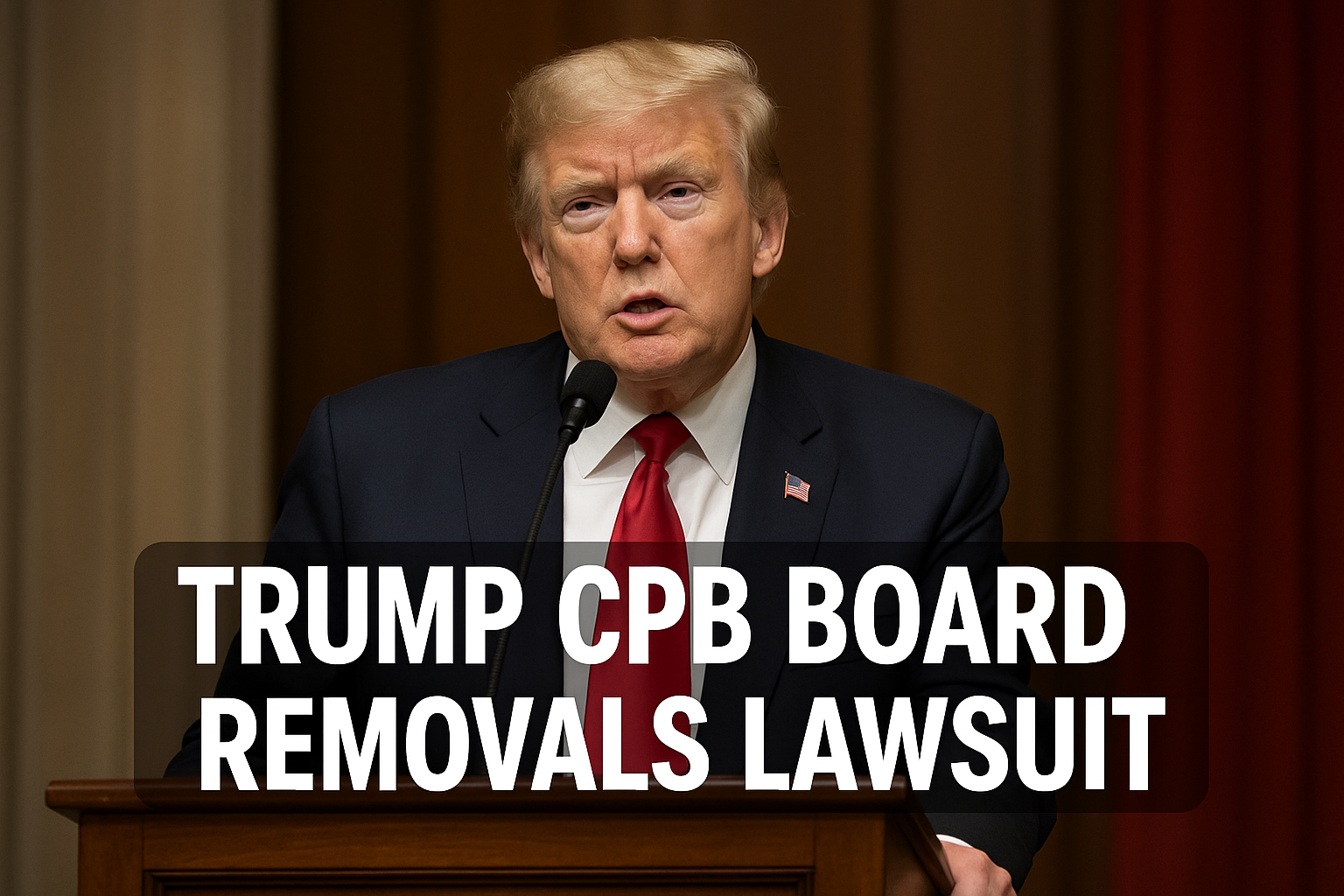
Trump CPB Board Removals Lawsuit: Everything You Need to Know
The phrase “Trump CPB board removals lawsuit” has been circulating across major news outlets and political discussions in recent months. This lawsuit highlights the controversial actions taken during former President Donald Trump’s administration regarding the governance of the Corporation for Public Broadcasting (CPB). For anyone following U.S. politics, media independence, or legal battles over federal appointments, understanding this case is essential.
In this article, we’ll break down the background of the lawsuit, why the CPB is important, the arguments being made, and what the possible outcomes could mean for media organizations and the American public.
What Is the Corporation for Public Broadcasting (CPB)?
The Corporation for Public Broadcasting (CPB) is a nonprofit corporation established by Congress in 1967. Its mission is to provide funding and oversight for public radio and television stations, including well-known outlets such as PBS and NPR.
Unlike commercial media outlets, CPB ensures that local and national stations can deliver programming focused on education, culture, and unbiased journalism. Because it receives federal funding, its board of directors plays a crucial role in ensuring transparency, independence, and accountability.
Board members are typically appointed by the U.S. president but are meant to serve staggered terms to prevent any single administration from dominating the board entirely. This balance helps protect CPB’s independence from political interference.
Why the Trump CPB Board Removals Sparked a Lawsuit
During his time in office, former President Donald Trump took unprecedented steps to remove and replace CPB board members before their terms had expired. Critics argued that this action violated the Public Broadcasting Act of 1967, which was designed to shield CPB from partisan influence.
Those who filed the lawsuit claim that Trump’s removals were unlawful because:
-
Board members have fixed terms – meaning they can only be removed for cause, not simply replaced at will.
-
The law protects CPB from political manipulation, ensuring its content remains free from direct government influence.
-
Abrupt removals disrupt continuity and oversight, undermining the CPB’s ability to fulfill its mission.
This case has since become a major flashpoint in the ongoing debate over whether public broadcasting should remain fully independent of political agendas.
The Legal Arguments in the Case
At the heart of the Trump CPB board removals lawsuit are two competing legal interpretations:
-
The Plaintiffs’ View: The lawsuit claims that the Trump administration exceeded its constitutional authority by dismissing members who were serving valid, congressionally mandated terms. They argue that this action violated both statutory law and democratic principles designed to safeguard free media.
-
The Defense (Trump’s Team): Supporters of Trump argue that the president has broad powers to appoint and remove federal board members. They claim that ensuring loyalty and alignment with an administration’s policy goals falls within executive authority.
This tension between executive power and statutory independence is what makes the lawsuit so complex—and so important.
Why This Lawsuit Matters for Public Broadcasting
The outcome of this lawsuit will have far-reaching implications. If the courts side with the plaintiffs, it will reaffirm the independence of CPB and set a strong precedent that presidents cannot arbitrarily dismiss board members. This would help protect NPR, PBS, and local stations from political interference in the future.
On the other hand, if the defense prevails, it could give future presidents greater leeway to reshape independent boards according to partisan priorities. This could fundamentally change the role of public broadcasting in American society.
For audiences, the issue is not only about who sits on a board, but whether public radio and television will continue to provide nonpartisan, fact-based programming free from political influence.
Media Coverage and Public Reaction
The case has been closely followed by journalists, policy experts, and advocates of free press. Many organizations see it as part of a broader struggle over media independence in the United States.
One of the most in-depth analyses of this issue can be found on NPR’s coverage, where journalists have explored both the legal aspects and the broader cultural implications.
Public reaction has been divided along political lines. Critics of Trump see the lawsuit as a necessary step to hold him accountable for overreach, while supporters view it as yet another politically motivated attack against his administration.
Possible Outcomes of the Trump CPB Board Removals Lawsuit
The courts could reach several different conclusions:
-
Reinstatement of Board Members – If the removals are deemed unlawful, the affected members could potentially be reinstated, or similar future removals could be blocked.
-
Expanded Presidential Power – If Trump’s actions are upheld, it could open the door for greater executive control over independent agencies.
-
Legislative Action – Congress may respond by clarifying or strengthening laws that limit presidential power over organizations like CPB.
Regardless of the outcome, the decision will likely influence how public media functions for years to come.
Final Thoughts
The Trump CPB board removals lawsuit is more than just a legal dispute—it is a test of how independent America’s public broadcasting system can remain in the face of political pressure. With so much at stake for media freedom and democracy, the case is being watched closely not only by legal scholars but also by millions of Americans who rely on CPB-supported programming every day.
As the lawsuit moves forward, its outcome will shape the balance between political authority and media independence in the U.S. for years to come.