
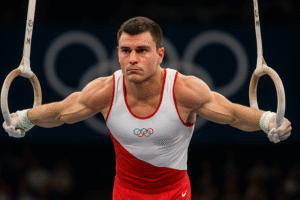
Gymnastics Rings Olympics: History, Rules & Iconic
Performances
The gymnastics rings Olympics event is one of the most physically demanding and awe-inspiring competitions in the world of sports. Combining immense upper body strength, balance, control, and precision, this event has earned a special place in the hearts of fans and athletes alike. From its historical roots to modern-day champions, the gymnastics rings event showcases the pinnacle of human strength and discipline.
In this article, we’ll explore the origins of the rings event in the Olympics, the rules and scoring system, the training required, and some of the most legendary performances that have defined this discipline.
What Are Gymnastics Rings?
Also known as still rings, gymnastics rings are a men’s artistic gymnastics apparatus consisting of two circular rings suspended from a frame. The gymnast grips the rings and performs a routine combining strength holds, swings, and a dismount. What makes this event exceptionally challenging is that the rings are not fixed—they require the athlete to control every micro-movement to stay stable.
Key facts about the rings:
-
Diameter of each ring: 18 cm (approx.)
-
Distance between rings: 50 cm
-
Height from the floor: 2.75 meters
The History of Gymnastics Rings in the Olympics
The rings event has been a part of Olympic gymnastics since the first modern games. Men’s artistic gymnastics was introduced in 1896 in Athens, and rings were among the earliest included apparatus.
Over the decades, the sport has evolved dramatically. In the early years, routines were simpler, focusing on basic strength moves. But as techniques, training, and equipment improved, so did the complexity and difficulty of performances.
Notable Historical Moments
-
1964 Tokyo Olympics: Japanese gymnast Yukio Endo performed an elegant and technically advanced routine that set a new standard for the sport.
-
1972 Munich Olympics: Nikolai Andrianov of the Soviet Union showed unmatched strength and style, dominating the rings and becoming a gymnastics legend.
-
2004 Athens Olympics: Dimosthenis Tampakos won gold on home soil, sparking national pride and worldwide admiration for his precise control and clean routine.
Rules and Scoring of the Rings Event
The International Gymnastics Federation (FIG) governs the rules and scoring for all gymnastics events, including the rings. Here’s how it works:
Routine Composition
A gymnast’s routine must include:
-
Strength Elements: Holds like the Iron Cross, Maltese, Planche, or Inverted Cross.
-
Swing Elements: Controlled circular or pendulum-like movements.
-
Transitions: Moving fluidly from one element to another.
-
Dismount: A high-difficulty flip or twist to land cleanly.
Scoring System
Since the 2006 scoring reform, the rings event uses a two-part score:
-
D Score (Difficulty): Based on the difficulty level of elements and combinations.
-
E Score (Execution): Starts at 10.0, with deductions for form breaks, instability, or poor landings.
A world-class rings routine will score between 14.5 to 16.0, depending on the combination of difficulty and flawless execution.
Training for Gymnastics Rings
Training for the gymnastics rings Olympics event is intense and requires years of dedication. Unlike other apparatus, the rings offer no stability, forcing athletes to build immense strength, especially in the shoulders, arms, and core.
Core Training Areas:
-
Isometric Strength: Holding positions like the Iron Cross or Maltese.
-
Shoulder Stability: Protecting joints during high-stress movements.
-
Body Control and Awareness: Managing small shifts in motion to avoid swinging.
-
Dismount Technique: Sticking the landing is often the difference between gold and silver.
Routines are practiced hundreds of times under the watchful eye of coaches to refine every detail and increase muscle memory.
Modern Olympic Legends of the Rings
In the modern era, several gymnasts have elevated the rings event to new heights.
Chen Yibing (China)
Dubbed the “Lord of the Rings,” Chen dominated the event from 2006 to 2012. His gold medal-winning routine at the 2008 Beijing Olympics was near perfect, demonstrating absolute control and grace.
Arthur Zanetti (Brazil)
Zanetti became the first Brazilian gymnast to win Olympic gold at the 2012 London Games, stunning the world with his composure and explosive dismount.
Eleftherios Petrounias (Greece)
Known for his incredible strength-to-weight ratio, Petrounias won gold in Rio 2016, adding to Greece’s proud history in the event. He’s also a multiple-time world champion and a fan favorite for his clean technique and calm demeanor.
If you’re interested in learning more about the history and current champions of Olympic gymnastics, including the rings event, visit this helpful resource on Wikipedia.
Why the Gymnastics Rings Event Stands Out
Among all Olympic events, the gymnastics rings hold a unique place. Here’s why:
-
It Combines Power and Grace: A good routine is not only about muscle—it’s about elegance and flow.
-
Precision is Everything: Even the slightest swing can result in deductions.
-
Spectator Appeal: The Iron Cross and other signature moves always get the crowd roaring.
-
True Test of Strength: There are few sports that test upper body control as rigorously.
Impact of the Rings Event on Gymnastics and Fitness
The influence of the Olympic rings goes beyond the competition floor. Many calisthenics and bodyweight training programs now incorporate gymnastic rings for building strength and mobility. Athletes and fitness enthusiasts alike use them to develop:
-
Core stability
-
Shoulder health
-
Functional strength
-
Balance and coordination
Rings have become a symbol of elite fitness and dedication, thanks largely to the visibility they receive during the Olympics.
Looking Ahead: Paris 2028 and Beyond
With the next Olympic Games set for Paris 2028, anticipation is already building for who will dominate the rings event. Nations like China, Greece, and Brazil are expected to field strong contenders, but emerging stars from around the globe may surprise us all.
As training methods become more advanced and athletes push the limits of human ability, the rings event promises to be even more thrilling in the years to come.
Final Thoughts
The gymnastics rings Olympics event is more than a showcase of strength—it’s a blend of discipline, skill, and artistry. Whether you’re a sports fan, a fitness enthusiast, or a content creator looking to rank for this powerful keyword, understanding the depth of this sport is key.
From its ancient roots to modern marvels, the still rings event continues to inspire millions. If you’re new to it, tune into the next Olympics and witness firsthand what makes this event so incredible.